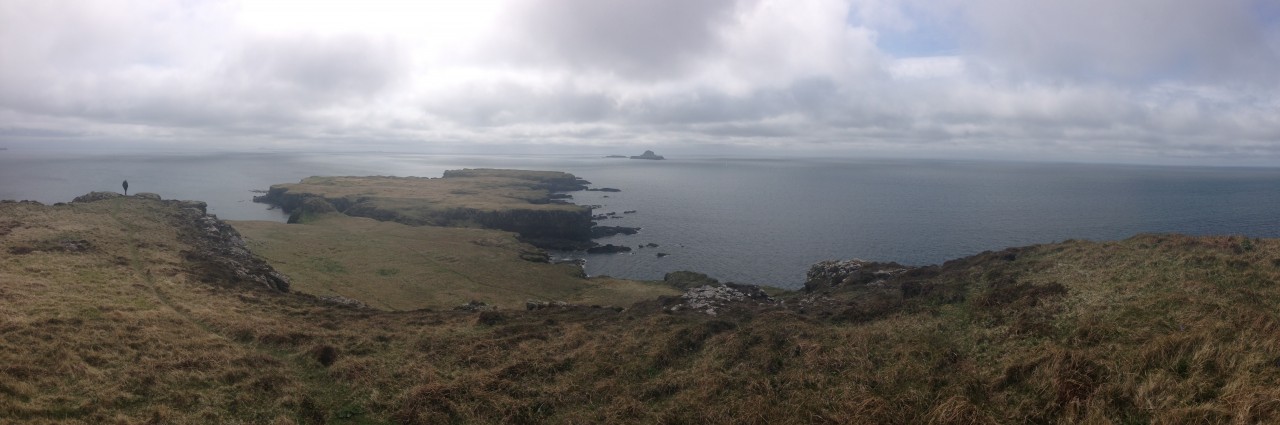
 The picture you see above you was taken on the isle of Lunga, about an hour off the western coast of Scotland; it’s the closest I’ve ever come to the feeling of standing at the edge of the world. What this has to do with music and movies – the two subject matters of this site – may not be obvious. But just as a map is defined by its boundaries, so too is art. It’s only at the edges where we can get a sense of the whole; where we can stand at the horizon, turn back and look inward, and appreciate just how far we’ve come. And at the edges of film and music, there are shadows and noise.
I’ve been a consumer of pop culture my whole life, and yet it is only now in my thirties that I think I’m beginning to understand it. For most of our history, our work was what defined us, but in the past couple of generations a shift occurred – now it’s our entertainments that do. The line separating mere diversion from art is so blurry that it’s no longer worth recognizing.
And so it is that an album like Radiohead’s Kid A or a movie like There Will Be Blood, for all of their overbearing ambition to mean something, are still a form of fun to us. Better yet, it’s also true (and I will fight to the death anyone who insists otherwise) that there’s a deeper merit hiding under much of what is dismissed as disposable pop fluff – from the music of Foo Fighters and Lana Del Rey and Jay-Z to movies as diverse as Swingers, The Avengers, Silver Linings Playbook, The Empire Strikes Back, or even the Fast & Furious series.
So if this blog has a mission statement, it is this: to serve as a conversation space about music and film that takes seriously both the fringe and the mainstream of our two greatest art forms. To engage equally both the experimental and the lowbrow. To be pretentious at times, and also to flip the finger at that sort of thing. To start at the edges, but to never stay there so long that we lose sight of the whole.
This site is a passing of the torch of sorts, jumping off where my good friend Antony’s earlier site, After The Radio, left off. I hope that some of the contributors to that site will stop by S&N from time to time to offer their voices, for I have truly enjoyed the conversation we have had over the past three years. And by expanding the scope beyond music and into film, too, I hope that we can have an even broader conversation about how our pop culture consumption shapes us, entertains us, makes us feel and gives us purpose – in short, how it connects us. Both to each other and to ourselves.
So read. Comment. Contribute. Consume. Engage. Because by doing so, you help it all mean just a little bit more.
 By Spencer, Antony, and Mark. Jack White’s second solo album, Lazaretto, dropped this week. Following a tradition started on our previous site, After The Radio, three of our S&N contributors engaged in a bi-coastal email conversation on the album and its place in the broader Jack White pantheon of musical experiences:




 Shadows & Noise